Directing Portfolio
Core to my directing philosophy is that artists, as much as anyone else, have a responsibility to engage with the world around them. My intent is to produce thought-provoking productions of classical plays which encourage audiences to consider contemporary problems.
The Winter's Tale
by William Shakespeare
Directed by Megan Parlett
Constellation Shakespeare Collective

Production Team
Stage Manager — Analise Toone
Assistant Stage Managers — Irene Keeney, Maggie Lengerich
Pre-Production Dramaturg — Grayson Fulp
Dramaturgs — Elle Lewis-Eme, Siena Maxwell
Costume Team — Sydney Brooke Crittenden, Louis Altman
Set and Props Team — Becca Westbrook, Jake Raiter
Music Director— Becca Westbrook
Fight Team — Jake Raiter, Louis Altman
Dance & Movement — Sydney Brooke Crittenden
Intimacy Team — D. Scarlet Darling, Maggie Lengerich
Cast
Louis Altman — Polixenes & Clown
Sydney Brooke Crittenden — Paulina & Autolycus
Grayson Fulp — Camillo & Shepherd
Jake Raiter — Leontes & Florizel
Becca Westbrook — Hermione & Perdita
Played by all: Time, all that was, all that is, and all that will be
This production was one of Constellation Shakespeare Collective's touring small-scale shows, which means five actors were responsible for every role in this play!
Director's Note
“Whatever [the actor] doesn't do must be contained and conserved in what he does. In this way every sentence and every gesture signifies a decision; the character remains under observation and is tested.”
Bertolt Brecht
The Winter’s Tale is a bizarre, fantastical play which requires its audiences to “awake their faith”, in which bears, oracles, and magic statues speak to the higher powers that control the characters' lives. But when I began making my cuts, I discovered that underneath these magical elements was a story of choice, not destiny. When Leontes' tyranny takes hold and the world turns upside down, we watch as these characters either choose to acquiesce or stand up to those in power, and their choices either perpetuate or begin to fracture the cycles of violence at play.
In an effort to draw attention to these choices and cycles, the actors perform within a literal chain of fate that constrains their movements, and each actor doubles in ways that draw attention to the different choices their characters make. By leaning into the meta-theatrical, I sought to highlight the moments where our characters, and our actors, choose to stand up against those abusing their power, denying that these cycles must continue just because they always have. I invite the audience to consider what role their own choices might play, especially in a world increasingly subject to the same violent cycles you see on stage.
– Megan


Photos by Ariel Tatum
Review
"The Winter’s Tale is a tale oft-told, its violences repeating both within the play and in production after production, as once more a jealous and powerful man destroys his world in pursuit of the destruction of a woman. This production’s radical change to the play’s conclusion pushed hard against the play’s narrative of forgiveness. [...] By showing a younger generation choosing their own story, unencumbered by the material memories of the past, it suggested that we should perhaps try to escape this story rather than resolve it, and to care more about the futures of those whose stories are not yet written."
Dr. Peter Kirwan, The Bardathon
Cast
Louis Altman — Macbeth
Emily Bassett— Macduff
Gray Casterline — Ross, Third Witch
D. Scarlet Darling — Banquo, Lady Macduff
Dennis Colin Graham — Fleance, Second Witch, Son
Jake Raiter — Duncan, Porter
Joan Raube-Wilson — Lady Macbeth
Becca Westbrook — Malcolm, First Witch
Macbeth
by William Shakespeare
Co-Directed by
Megan Parlett & Sydney Brooke Crittenden
Constellation Shakespeare Collective
Director's Note
Who is scarier: the monster in the woods, or the man on the throne?
In considering Macbeth for our education slot, we sought to elevate the idea of choice – our choices, and the consequences that come with them, are something that we all must learn to be aware of (regardless of whether you’re a student choosing an extracurricular or a Scottish Thane choosing to kill the King of Scotland). At the start of the play, Macbeth and Banquo are both faced with a prophecy. They don’t know where it comes from or how it will come to fruition, but only one of them decides to commit regicide. By placing this focus on choice at the forefront of our production, alongside our Southern Gothic lens, we’ve discovered the vitality of decisions and their consequences throughout our fast-paced 60-minute adaptation of one of Shakespeare’s most violent plays.
The Southern Gothic genre seeks to unveil the disturbing side of human nature that hides beneath a polished surface. Considering Macbeth through this lens aided tremendously in highlighting the inherent consequences of our characters' actions, as we watch Macbeth sacrifice the lives of others again and again in the quest for power. The supernatural simply reveals the evil that humanity is capable of, digging into the dark underbelly of all of our characters and illustrating that only they can be responsible for their own choices – whether it’s ambitiously grasping for power or opposing it.
We ask our audiences to consider who is scarier: the monster in the woods, or the man on the throne? The animalistic, discordant nature of the witches is perhaps terrifying because it is unknown or different from what we are familiar with, while the violence of Macbeth is actualized in the blood he’s spilled for his own ends. We ask you to contemplate how terrifying human nature can be when presented with notions of ambition, greed, and power. Macbeth brings the audience face to face with tyranny, and you must decide for yourself who’s right or wrong; good or evil.
-Brooke and Megan

Production Team
Stage Manager — Grayson Fulp
Assistant Stage Managers — Vex Bauer, Sam Mundy
Pre-Production Dramaturgs — Louis Altman, Kim Cincotti-Seldon
Dramaturgs — Analise Toone, Oliver Chase Marten
Witch Consultant — Gray Casterline
Costume Team — Emily Bassett, Gray Casterline
Props & Set Team — Dennis Colin Graham, Gray Casterline
Music Team — Becca Westbrook, Gray Casterlin, Joan Raube-Wilson
Fight Team — Becca Westbrook, Jake Raiter, Louis Altman
Dance & Movement Team — Jake Raiter, Dennis Colin Graham
Intimacy Team — D. Scarlet Darling, Maggie Lengerich


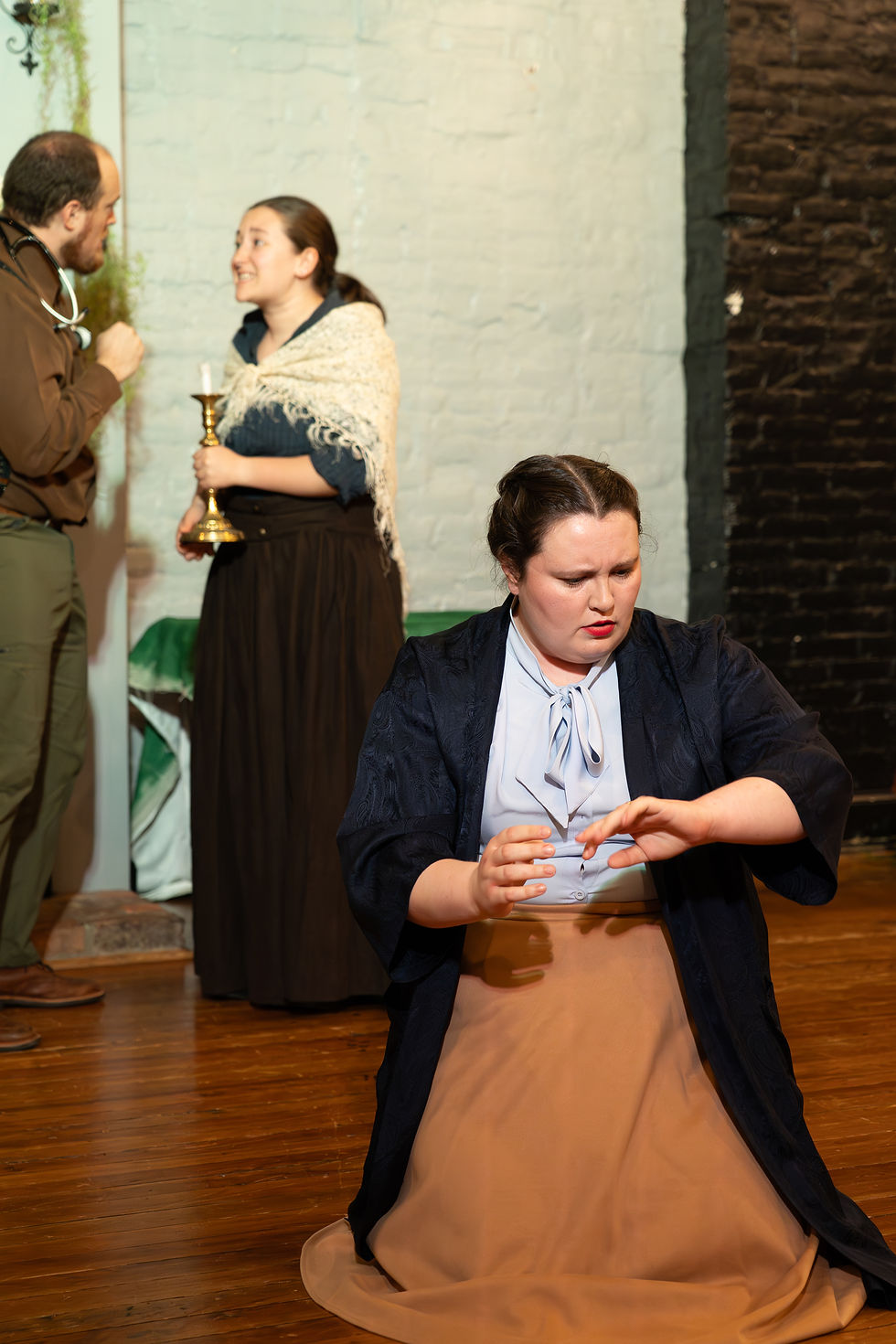
Photos by Ariel Tatum
Review
"But perhaps the more pertinent question to emerge from Constellation Shakespeare Collective’s new touring production for middle- and high-school students was “Are we scared enough?” For in this tight cut, which leaned heavily into horror tropes, it seemed that perhaps the tragedy came hardest for those who did not sufficiently fear that which they should; those who, even in the face of the objectively terrifying, chose complacency, over-confidence, or simple inaction. If fear is a survival instinct, then CSC’s Macbeth warned its audiences to take that instinct seriously."
Dr. Peter Kirwan, The Bardathon
As You Like It
by William Shakespeare
Co-Directed by
Megan Parlett & Becca Westbrook
Mary Baldwin University
Production Team
Stage Manager — Hailey Pearce
Assistant Stage Manager — Analise Toone
Dramaturg — Tommy Hegarty
Costume Designer — D. Scarlet Darling
Hair & Makeup — Aubree J. Gray
Set Designer — Sydney Brooke Crittenden
Props Master — Gray Casterline
Lighting Designer — Johnny Williams III
Music Director — Joan Raube-Wilson
Fight Director— Gray Casterline
Movement — Aubree J. Gray
Intimacy — Matthias Bolon
Pub/Mark — M. Finch
Cast
Louis Altman — Touchstone
Emily Bassett — Phoebe
Gray Casterline — Adam
Sydney Brooke Crittenden — Celia
D. Scarlet Darling — Rosalind
Grayson Fulp — Orlando
Aubree J. Gray — Amiens, Corin, etc.
Dennis Colin Graham — Duke Senior, etc.
Jacob Raiter — Charles & Silvius
Joan Raube-Wilson — Oliver & Jaques
Director's Note
As [We] Like It
We often see The Forest of Arden depicted as a transitional space before our characters return to the ‘proper’ behavior of the court, a textbook depiction of ‘the green world’. In our version of The Forest of Arden, we embrace a space that steers away from the liminal and into the concrete. Our aim is to present a place that is lasting, that you don't have to return from.
So what is “The Forest of Arden” without the forest-y aspects? We are notably bereft of trees, goats, and shepherds in this production. Instead of being a space of exile, Duke Senior has created The Forest of Arden as a refuge from the world that has shunned him. Thus, the bar “The Forest of Arden” was born. In this framing, we shift away from the temporality of the forest into a queer space of acceptance. You no longer have to escape reality to find a place of belonging; there are actual places you can go to that are just as real as the repressive ones.
As you enjoy this story with us, we ask that you consider the value of creating spaces of discovery and acceptance that you don’t have to return from.
Enjoy the show, Foresters!
Becca and Megan


Photos by Ethan Goodmansen
Review:
"The Forest of Arden is many things to many people: a place of work, a place to waste one’s time, a place of fear. But for Megan Parlett and Becca Westbrook’s production starring the MBU Shakespeare & Performance first years, it was more than anything else a place of refuge and community. By reimagining the sprawling pastoral Forest of Shakespeare as a queer-friendly bar in 90s America, the production reversed the usual movement from court to country and instead found liberation in the confined walls of a single small sanctuary from the outside world, whose inhabitants rubbed shoulders closely with one another and were able to, as the song told us, express themselves."
Dr. Peter Kirwan, The Bardathon